What Is rPPG? How Your Phone Camera Can Measure Your Vital Signs
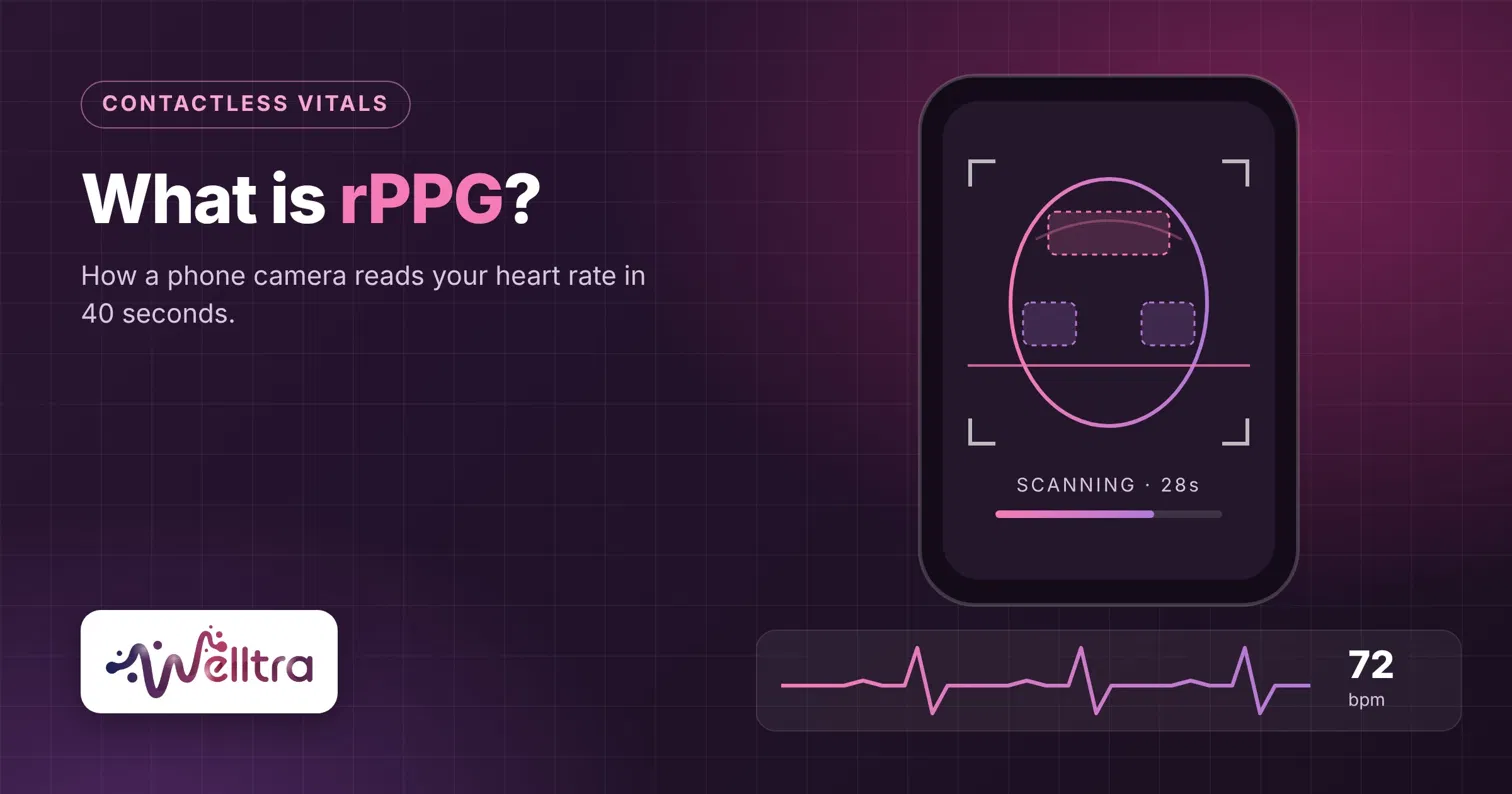
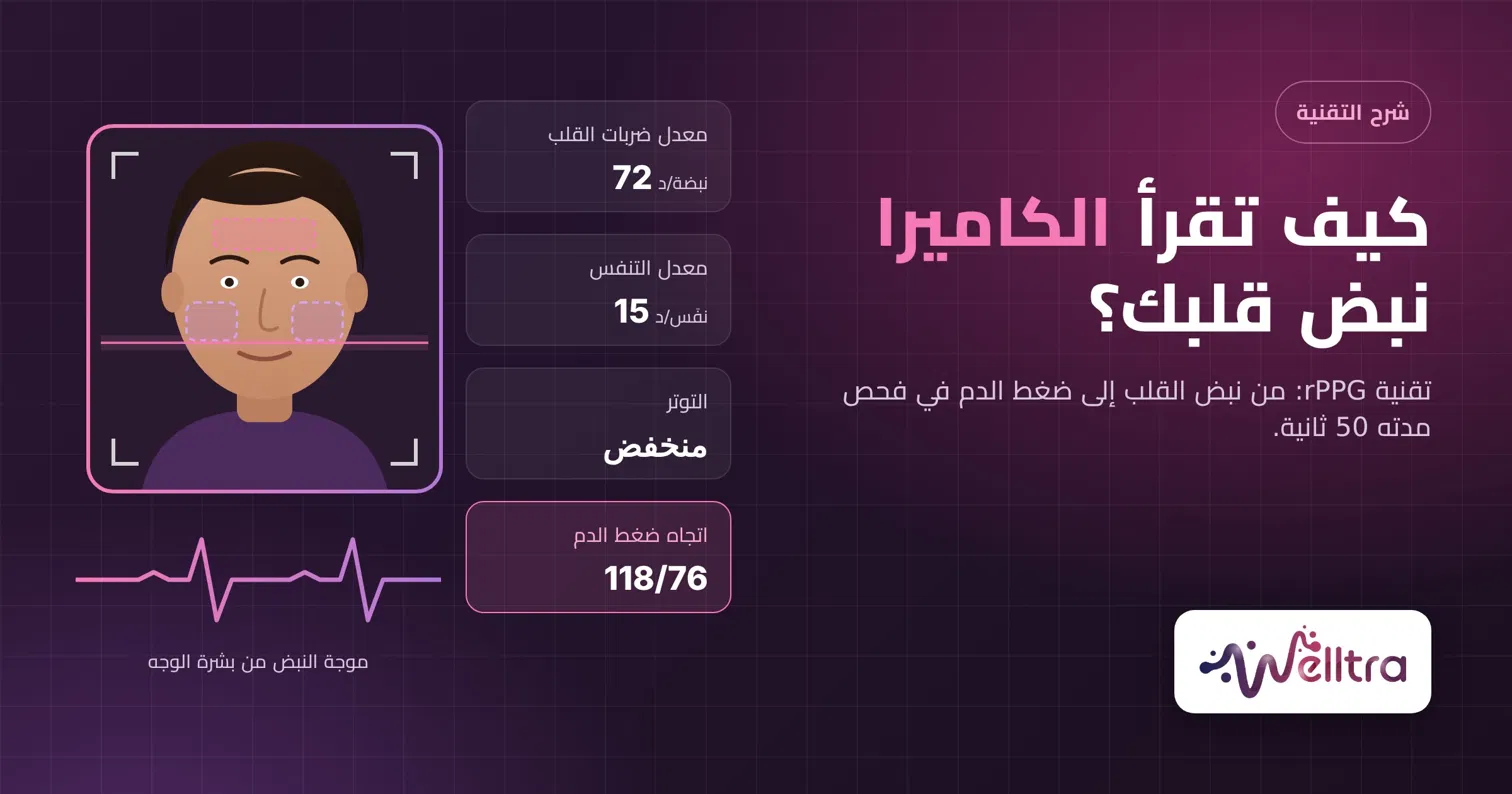
Remote photoplethysmography (rPPG) is a way to measure vital signs using an ordinary camera. Every heartbeat pushes blood into the skin of your face, which changes how much light the skin absorbs. The change is too small for the eye to see, but a camera picks it up. AI turns that signal into heart rate, breathing rate, heart rate variability and other wellness indicators, with no wearable or cuff.
With Welltra, a scan takes 50 seconds on a phone, tablet, kiosk or smart mirror.
How does rPPG work?
rPPG builds on the same principle as the pulse oximeter clipped to your finger at a clinic. That device shines light through skin and tracks how blood volume changes with each beat. rPPG does the same thing remotely, using ambient light and a camera.
- The camera records a short video of your face.
- Software locks onto skin regions with strong blood flow, such as the forehead and cheeks.
- It tracks tiny colour changes in each frame, mainly in the green channel, where haemoglobin absorbs light most.
- AI models clean out noise from movement and lighting, then extract the pulse wave.
- The pulse wave is analysed for rate, rhythm and shape, which yields the vital-sign estimates.
Why does contactless screening matter?
Most people do not get checked often enough. Fewer than 10% of US adults aged 35 and over receive all recommended preventive care (USC Marshall). Any device with a camera can now act as a screening point, which removes cost, hardware and travel from the equation.
That opens uses that cuffs and wearables can’t reach:
- Telehealth: clinicians see vitals during a video consult.
- Remote patient monitoring: doctors follow patients from a mobile app and are prompted when readings fall outside set ranges.
- Elderly care: daily scans at home, logged automatically, without devices to charge or wear.
- Workplaces and insurers: kiosk check-ins and app-based screening at population scale.
- Clinics: faster triage in waiting rooms with no shared equipment to sanitise.
How is Welltra using rPPG?
Welltra is a contactless, multimodal health screening platform built for the world. It combines rPPG vital signs with voice biomarkers and AI-guided urinalysis, so one session covers more than any single sensor. Welltra runs on smartphones, kiosks and Ru’ya, its smart mirror, and partners with health authorities in Saudi Arabia and the UAE.
FAQ
Is rPPG safe? Yes. It only records video with a normal camera. Nothing touches the body and no radiation is emitted.
Do I need a special camera? No. A modern smartphone or webcam works. Even, front-facing light improves results.
Can rPPG replace a doctor’s measurement? No. It’s a screening and tracking tool. Abnormal readings should be confirmed with a clinician.
How long does an rPPG scan take? Research protocols use 20 to 60 seconds. A Welltra scan takes 50 seconds.
Does skin tone affect rPPG? It can, because darker skin absorbs more light. Good models are trained on diverse skin tones, which matters for GCC and South Asian populations.
Welltra provides wellness indicators and is not a substitute for professional medical diagnosis.